The November Graph
If the 300 voting-right threshold for making a shareholder proposal in Japan is abolished, small investors will have an impossible mountain to climb.
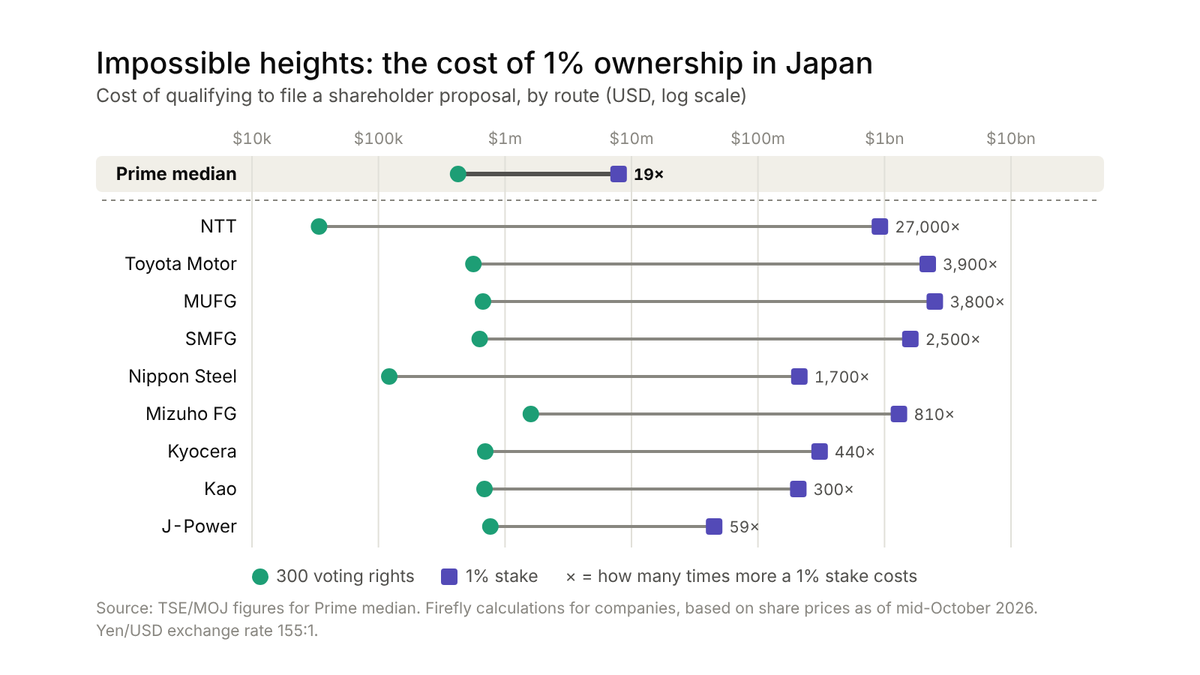
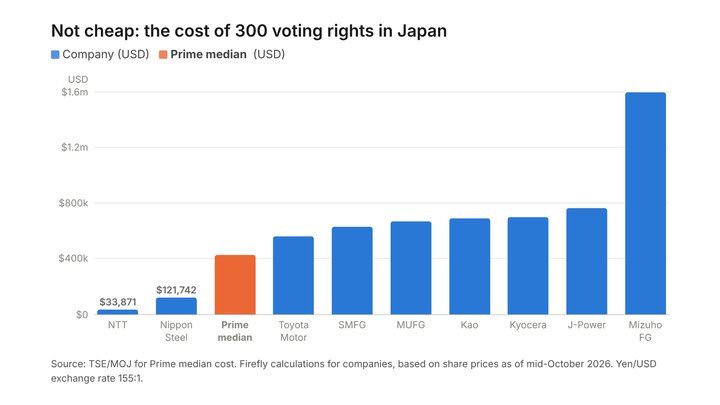
Buying 300 "voting rights" or 30,000 shares is not cheap in Japan, as we showed in our recent article "Putting rights in reverse, Part 2: The data do not support change". Yet with the government moving towards abolishing this avenue for making a shareholder proposal, that so far leaves only one other option: ownership of 1% of total voting rights.
As our graph indicates, this would be wholly unattainable for retail shareholders and most other small investors of large-cap issuers who have relied on the 300 voting-right criterion, such as boutique investment funds and civil society groups. The multiple ranges from 59 times at J-Power to 1,700 times at Nippon Steel and an extraordinary 27,000 times at NTT – a difference exaggerated by the very low share price of the telecoms giant and three stocks splits over the past 11 years.
Lest readers think it gets a great deal easier for shareholders of the median average Prime Market company, the relatively low 19-times multiple is largely a product of the high absolute cost of 30,000 shares – around US$426,000. Buying a 1% stake at such a company will tie up around US$7.9m.
What is the market impact of this probable company law amendment? A likely 60% drop in the number of shareholder proposals put forward.
jallen@fireflyreads.com
Copyright: Ninepin Ltd, 2026
Comments ()