How far will HKEX go in the name of competition?
Shareholder voting rights may become the next governance protection to face scrutiny
Every stock exchange has its defining moments. For Hong Kong, losing the 2014 listing of Alibaba to New York was one. It reshaped the listing rules and ushered in weighted voting rights (WVR), allowing a new generation of Chinese tech companies to come home.
Last week’s decision to revise the rules to allow more WVR may ultimately prove just as significant. Not because it opened the door to more companies, but because it brought a shift in how HKEX frames reform.
The Exchange billed the reforms as the opening chapter of a broader “competitiveness review” of Hong Kong’s listing framework. Rather than asking why a governance protection should be changed, the question has now become whether it can still be justified on competitiveness grounds.
The catch is that HKEX uses “competitiveness” in a fairly one-dimensional way. From the consultation paper, it largely means making Hong Kong a more attractive place for companies to list. There is much less discussion of whether the rules themselves might be part of what makes Hong Kong competitive in the eyes of investors.
The bourse left little doubt about the direction of travel: “…this paper seeks feedback on proposals that intend to minimise regulation as a factor in the consideration for such companies when choosing a listing venue.’’
The first phase of the review loosened Hong Kong’s approach to unequal voting rights, doubling the maximum voting ratio from 10:1 to 20:1, relaxing eligibility requirements and moving further away from the principle of one share, one vote.
Looking ahead, if the broader objective is to minimise regulation as a factor in attracting listings, it is reasonable to ask which governance protections might come under scrutiny next. One area worth watching is shareholder voting thresholds.
For more than two decades, major transactions exceeding 25% under Chapter 14 of the Listing Rules have required shareholder approval (with disclosure from 5%). Issuers must publish a detailed circular, explain the rationale for the deal and give shareholders time to scrutinise it before voting.
But shareholder votes have become a target of reform in other markets amid arguments that it constrains corporate dealmaking. This is particularly so in London, where policymakers concluded that they left listed companies at a disadvantage in the context of competitive M&A.
The London lens
Faced with a shrinking IPO market and a highly politicized quest for growth, the UK in 2024 rewrote decades-old listing rules to make it easier for companies to raise capital, do deals and remain listed. One of the biggest changes was the removal of a mandatory shareholder vote for significant transactions.
The case for abolishing the vote was that it was making UK companies slower and less competitive buyers in M&A transactions. Private equity and privately-owned peers were more nimble, with sellers favouring bidders who could execute faster. Listed companies were losing deals or paying a premium as well as having to foot the bill for regulatory costs their private rivals simply didn’t have to bear.
It is not difficult to see why this argument would resonate in Hong Kong. Its pipeline of mainland Chinese issuers gives it a structural advantage few exchanges can match, but the broader pressures are familiar: a shrinking pool of IPOs globally, companies staying private for longer, more permissive US markets and the rise of private equity with an ability to move quickly.
In the context of PRC national champions expected to acquire technology, reorganise businesses, spin off subsidiaries and respond quickly, HKEX could argue that the process of preparing a circular, waiting for a general meeting and adhering to stiff regulatory timetables are no longer commercially efficient.
It would be an easy sell to issuers, lawyers and banks. Boards, management and controllers would welcome greater flexibility, investment banks would argue it improves execution, and lawyers would enjoy the additional transactional work and fewer procedural hurdles. HKEX gets to say it improves the attractiveness of the market.
With founders, families or state shareholders frequently controlling a majority of the voting rights in any case, supporters of such a rule change could also argue that under the current regime mandatory shareholder approval can introduce weeks of delay and significant cost without materially changing the outcome.
Catnip for small caps
Independent shareholders would argue the opposite. In a market dominated by founders and controlling shareholders, an independent vote is one of the few formal checks available to minorities.
The vote may rarely change the outcome, but it creates a pressure point and forces boards to explain and defend transformative transactions in public. A formal vote is one of the rare opportunities where minorities can hold boards to account.
Looked at it one way, the requirement for a shareholder vote is a logistical burden. But it is also a discipline for smaller issuers: remove the framework, and the transaction becomes easier to execute. This removes one of the principal safeguard against dubious transactions.
Making well-governed companies more agile could just as easily make life easier for those with a patchier governance record looking to shuffle assets, transform the business or repeatedly reinvent themselves. Those skilled at working the existing rules would simply have fewer constraints to work around [See our previous article: The chutzpah of Hong Kong small caps.]
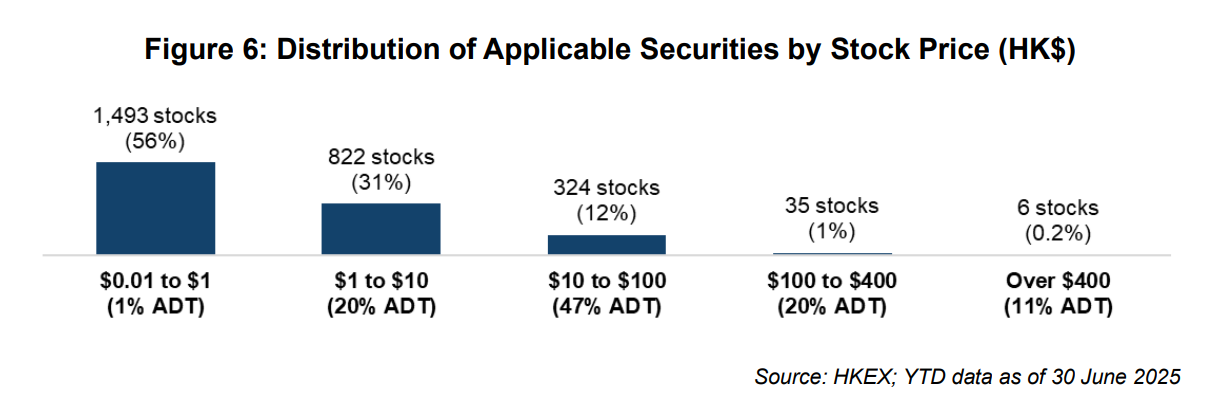
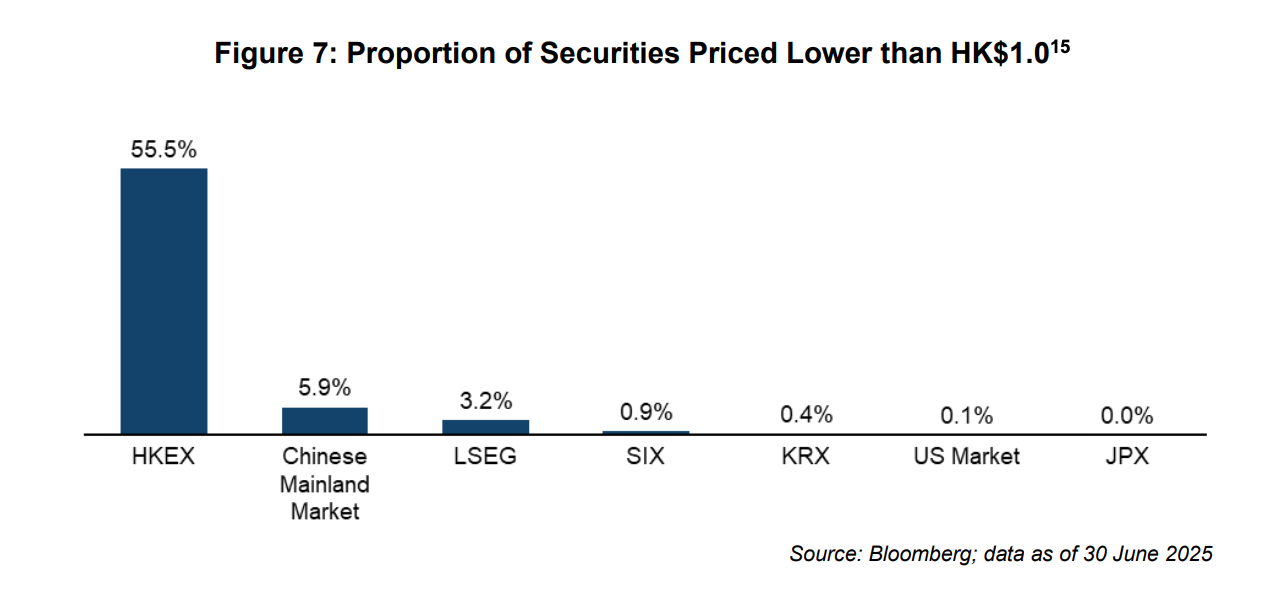
This matters because any relaxation of Chapter 14 would not just apply to Hong Kong’s blue chips but would affect a market where more than half of the listed securities trade below HK$1—an outlier among major exchanges:
Source: HKEX
The burden of proof
The WVR reforms were an easier case to make. Hong Kong could point to Alibaba and a pipeline of Chinese companies it wanted to attract. Explaining why shareholders should vote less in order to attract more IPOs is a taller order.
Britain’s Financial Conduct Authority (FCA) struggled with this. Its own consultation acknowledged that there was no hard evidence to show that shareholder votes were stifling M&A. It relied instead on consultation responses and market experience of banks, lawyers and issuers.
Two years on, there is no statistic suggesting the reform resulted in a surge in M&A activity by UK-listed companies, even if the mechanics of doing deals have become simpler and faster.
That leaves some obvious questions should Hong Kong head down the same path. How many acquisitions have actually failed because of Chapter 14? How many listed companies have lost competitive bids? How often have shareholder votes altered the outcome? Which issuers bear the greatest compliance burden?
Whether Chapter 14 is next remains to be seen. But if “competitiveness” is now the organising principle of reform, changing the shareholder approval regime would represent one of HKEX’s biggest strategic bets in years. If this is the case, investors may reasonably ask to see the odds.
Copyright of Ninepin Limited, 2026